Showing posts with label spending journal. Show all posts

Wednesday, June 13, 2007

Spending Money Like it's going out of style

Monday I got a call at work from the concrete guy wanting to know if he could start that day. Well I had been sick since Wednesday (food poisoning or something) so I hadn't dismantled the stepping stones and mulch by the raised beds or cleared off the sidewalks. I told him he could but that I was at work.

They took care of clearing everything away and had hauled away the old concrete and dug most of the new forms. I was very impressed with how quickly they worked.

Then they came back this morning finished digging out the new front sidewalk and poured the cement. It was dried by time I got home from golf.

It looks so nice I love it!! I didn't get a chance to take "Before" pictures so I'll have to look and see if I have any where the walks just happened to be in it. Tomorrow I'll get some of the "After".


The cost of this project was $1,800. The steps for the front are being made (they didn't have 5' wide and 5 high in stock) and they should be around $800 delivered and set up. The reason I'm not 100% sure of the cost is because the quote was $760 but with black iron railing and I want the railing to be white so he has to paint them.


The other money that flew out was for 2 new golf clubs. I decided to get a new driver.


The one I'm using now came with my set which I've had for several years. The head is pretty small. I hit very straight but don't get much distance (I'm breaking my wrist at the wrong time-hard habit to break). I'm hoping this club will help with topping the ball too.

I'm also getting this hybrid club to replace my 3 wood.


So that was $317.98 plus I've ordered new golf outfits from Puma, LizGolf and eBay. I think I'm making up for not spending much money last year.

$8.00 Bone Island Grill
$3.00 Beaner's
$5.00 Golf
$2.00 pop @ golf

Thursday, April 19, 2007

Good Finance Habits

EVERYDAY CHEAPSKATE, Apr 18, 2007 - Mary Hunt (click here to signup for everyday email tip)

Six Habits of Financially Responsible People

Funny thing about habits. Bad ones just happen while good ones are usually the result of considerable effort.

Habits are what personal character is made of, and basically they come in just two varieties: good and bad.

Some people act as if their habits were as predetermined as their blood type and are about as likely to ever change. But there are a select few who live by the truth: It is possible to learn good habits and unlearn bad ones, no matter how ingrained they are. It's all a matter of choice.

The secret of learning good habits or breaking bad ones is in choosing to repeat—or refrain from doing—something over and over and over again until it becomes a natural response, a habit.

Want to become more financially responsible? Here are the habits of those who are. Consciously focus on these actions, then repeat them over and over until they become natural responses.


Habit 1: Financially responsible people regularly balance their checkbooks. They calculate a current balance after every transaction and always know the exact state of their money.

Habit 2: Financially responsible people think first and spend later. Thinking means weighing needs and acknowledging wants. It means exercising discipline and delaying gratification—saving the money first and then buying the item.

Habit 3: Financially responsible people save money consistently. They never spend all they have because they are habitual savers. They see saving as a long-term process and make the sacrifices necessary to reach their goals. They are patient, steady, consistent and find saving money to be a necessity.

Habit 4: Financially responsible people fund their own emergencies. They don't buy into the notion that the purpose of credit cards is to pay for unexpected emergencies. Financially responsible people realize that life happens, and so they maintain significant emergency funds. Just in case.

Habit 5: Financially responsible people know their financial condition precisely. These folks usually know within a few bucks the current balance on their mortgage or other secured loans. They regularly update their net worth, which is the difference between the value of their assets and their liabilities. They make each financial move in light of the effect it will have on their net worth.

Habit 6: Financially responsible people refuse to live under the fantasy of entitlement. While others feel entitled to run up huge credit-card debt simply because they have an approved limit and uncontrollable desires, financially responsible people don't approach life with this feeling of entitlement. They are not driven to keep up with their neighbors at any cost. They are content to live within the limitations of their income.

Becoming financially responsible is a process. I sabotaged myself for many years, convinced that I could never change. But I was wrong. I have changed and continue to make new progress every single day.

It all starts with a single step: A decision to become financially responsible. And then it's just one step at a time—again and again. One good habit after another.

I'm very good at all of these except occasionally #2. Usually I'll wait forever to buy something. For instance, I had a TV in my bedroom, it was a hand-me-down from my aunt. It was so old it still had a knob to turn the channel and another one to turn it on and adjust the volume. Hee. Well it finally died. I kept checking ads and the internet for a year waiting a rock bottom deal.

One day I went to a bicycle shop with my brother (he was there to get something) and I was bored and tried on a pair of sunglasses. I didn't need them but I bought a pair for $183.

I'll wear a pair of canvas Keds until the tread on the bottom is smooth and they have holes in the toes. (I've been tempted to then use duct tape but I haven't done it yet)

As you can see I really need to work on #2 on my impulse items.

$1.25 Pepsi from machine
$0.25 snack box

Saturday, January 27, 2007

Frugal

Living within your means. But what exactly does that entail? Well for one, don't spend more than you make. Pretty easy actually. If you bring home $500 per paycheck, spend less than that, not more. Don't use credit cards if you are tempted to overspend. Set up a budget then stick to it. Put money in an emergency fund so that you don't have an unexpected expense which will set you back. Use a spending journal to track where EXACTLY you can cut unnecessary spending.

I'm not sure if the term "Keeping up with the Jones' " is still used but I'm sure you know what it means. Who are you REALLY trying to impress by driving a Hummer and/or a Cadillac that you can't make the payments on? Why have a $200,000 with 4 bedrooms 3 baths for a couple with no children? Especially if you then have no money to keep up with maintaince?

My two favorite sayings are, "Anyone can make a payment" that's my original saying. Yeah you may drive a Hummer but is is PAID for? Can you sleep at night? Or are you tossing and turning worrying about how to pay the bills? Are you afraid that when you get home from work that today will be the day that the electric company turns off the power and you'll have no lights? Life is stressful enough, why add extra unnecessary stress?

My other saying that I read in a finance book (can't remember which one) is, "Big hat, no cattle". Yeah you LOOK successful, but you aren't. You're just pretending. Posing. Big deal. I'd rather be the frugal little old lady that people think is poor but when I die my will is read and it's discovered I'm a millionaire.

I prefer to live BELOW my means and not worry about how I'm going to pay the bills every payday. The stress is really not worth it.

Trust me.


$1.25 Cherry Coke

Tuesday, January 9, 2007

Emergency Fund

Even if you are juggling bills now, it's VERY important to start an emergency fund. I recommend $100-200. This is money that is set aside for things that come up that need to be taken care of right away. For example: car repairs, furnace breaks, waterheater gives out, etc. Either keep it in an account where it would be easy to either transfer to checking account or transfer as payment on credit account or if necessary, in cash.

Since we are keeping a spending journal it should be easy to see where to cut down on spending and put that money into an emergency fund instead. Most areas where it's easy to cut spending are eating out (especially lunch),clothing & entertainment.


$10.00 doctor co-pay
3.69 Beaner's (coffee)

Monday, January 1, 2007

Getting Started in 2007

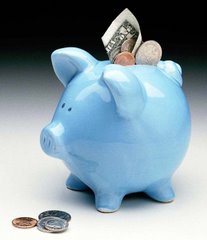
Welcome to my new blog!!! This Little Piggy Went to the Bank (with all of the money she earned/saved!!)

My goal with this blog is to help organize my thoughts on getting finances in order, sharing ideas, continue learning, etc. Take what you want, leave the rest. If I can help even one person that would be great.

I'm pretty happy with my current financial situation but there is always room for improvement.


Today's Assignment:

For today and going forward...write down every penny you spend. I have a small notebook I keep in the car and I write it down there. I transfer that info to an Excel spreadsheet and print it out at the end of the month. At least for this month, I'll post my expenditures here also.


$2.10 gas station---coffee/pop