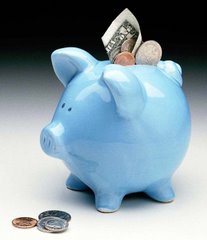
Meet Jane. She has a mortgage payment that is too big, two sons in college, credit card bills, a big loan -- and, finally, a game plan. (not sure why it was noted that the sons are in college, from this article it doesn't appear she is paying anything towards their education or living expenses.)
Jane is 52 and works as a secretary in eastern Massachusetts. Her youngest son turned 18 in May, and at that point $12,000 a year in child support stopped coming.
Jane has a long way to go to get her finances straightened out. What makes her a terrific addition to the Women in Red is her level of commitment.The good news is that Jane was prepared for this moment. (she may have known that his birthday was coming but in my opinion she was in NO WAY prepared)
The bad news is that she took out a $26,000 personal loan, which was co-signed by a friend -- and the loan has to be repaid in full by December 2008. (evidently the money wasn't earmarked for anything specific just day to day living)
The good news is that Jane owns her condominium and has about $150,000 in equity. (She couldn't qualify for a home-equity loan because of her credit history.)
The bad news is that it looks like she has to sell the condo in order to repay the loan next year. (it doesn't appear that she is making payments on the loan based on her list of monthly expenses.)
The good news is that this might be for the best: Jane can't really afford the condo. While it's in a good area and could be a good investment, the monthly mortgage and fees come to more than $1,400 a month. (her home is 76% of her income!! most analysts recommend 34%)
The really bad news is that Jane's take-home pay now, without the child support, is $1,840 per month.Jane is 52 and works as a secretary in eastern Massachusetts. (her monthly expenses are $3,208. Anyone can see what happens when you spend MORE than you make. She's running at $1,368 negative a month or $16,416 a year. Even when she was getting the child support she was still over spending.)
Even though the article mentions briefly a "health issue" that makes taking on a second job "difficult", there has to be something she can do part-time that wouldn't be too strenuous.
It doesn't sound like she's going to sell her condo but that really is her biggest expense (76%). Plus $400 on food. Damn what does she do eat all the time? She can nickel and dime the other expenses but without making payments on that loan which comes due in 12 months the only solution I see is selling and moving into a much cheaper place and start saving for retirement.
This article was from September, I looked for an update but didn't find one. Hopefully, her situation will be updated soon.
Showing posts with label budget. Show all posts
Showing posts with label budget. Show all posts
Sunday, November 18, 2007

Wednesday, November 7, 2007
Hard Times Hit Home
Hard Times Hit Home:
A Family's tale of foreclosure
From the story I'm going to assume they have 4 children and make approximately $75,000 or $6,250 monthly when the story started in 2001.
They moved to Michigan in 2001 and bought a home with a mortgage payment of $1,336 per month or 21% of his salary. It sounds like his is the only income. So far, good. I'm not good with dimensions and spacial awareness but 2,650 sounds reasonable.
In 2003 they decide to build a new home, the wife says of the builder, "we were mutually trying to help each other out." This in my opinion is where the fall started.
#1 They already had an adequate home
#2 No mention of an increase in salary
#3 Who buys or builds or takes on more debt "to help" some else out"?
#4 They got greedy and/or tried to "keep up with the Jone's" (even if the Jone's were imaginary)
They had expected the new mortgage payment to be $1,600. The wife says, "who wouldn't do it?"
I can answer that. I wouldn't. I can also find probably 5 to 10 other people pretty quickly who wouldn't have done it either. Especially with 4 kids. I wouldn't exactly call it EXTRA but if you have and extra $264 per month to pay for a new house I'm sure I could stay in the original house and find a better way to invest that $3,168.
Of course after putting the cart before the horse, the story get worse. Much worse. Blah, blah, blah.
Lost both houses. Lost his job. He got cancer. The kids had to switch schools. Now all six (?) are crammed into a two bedroom apartment. Their stuff is in storage. The story doesn't say but I can't imagine they have any or much savings left. Looking for jobs.
It's sad but I think that people should learn to live within or below our means because we never know what can happen.
I've been at my job, in three different cities, now maybe a fourth for 12 years but for the last 9 or 10 years it's been with no security that there won't be an announcement that the job has been eliminated.
I try (not very well) to spend or not spend, like this week will be my last paycheck because it could be.
A Family's tale of foreclosure
Sunday, October 14, 2007
By Cami Reister
The Grand Rapids Press GRANDVILLE -- Greg and Tracy Sweeney share a bedroom in their 1,000-square-foot apartment.
Three of their school-age children are in the other, where mattresses are squeezed next to each other on the floor. Their oldest sleeps in a rollaway in the living room.
"You have to wait in line to use the bathroom. Wait in line to get into the kitchen. Wait in line to go into the living room," Tracy said.
(click title to read rest of story...)From the story I'm going to assume they have 4 children and make approximately $75,000 or $6,250 monthly when the story started in 2001.
They moved to Michigan in 2001 and bought a home with a mortgage payment of $1,336 per month or 21% of his salary. It sounds like his is the only income. So far, good. I'm not good with dimensions and spacial awareness but 2,650 sounds reasonable.
In 2003 they decide to build a new home, the wife says of the builder, "we were mutually trying to help each other out." This in my opinion is where the fall started.
#1 They already had an adequate home
#2 No mention of an increase in salary
#3 Who buys or builds or takes on more debt "to help" some else out"?
#4 They got greedy and/or tried to "keep up with the Jone's" (even if the Jone's were imaginary)
They had expected the new mortgage payment to be $1,600. The wife says, "who wouldn't do it?"
I can answer that. I wouldn't. I can also find probably 5 to 10 other people pretty quickly who wouldn't have done it either. Especially with 4 kids. I wouldn't exactly call it EXTRA but if you have and extra $264 per month to pay for a new house I'm sure I could stay in the original house and find a better way to invest that $3,168.
Of course after putting the cart before the horse, the story get worse. Much worse. Blah, blah, blah.
Lost both houses. Lost his job. He got cancer. The kids had to switch schools. Now all six (?) are crammed into a two bedroom apartment. Their stuff is in storage. The story doesn't say but I can't imagine they have any or much savings left. Looking for jobs.
It's sad but I think that people should learn to live within or below our means because we never know what can happen.
I've been at my job, in three different cities, now maybe a fourth for 12 years but for the last 9 or 10 years it's been with no security that there won't be an announcement that the job has been eliminated.
I try (not very well) to spend or not spend, like this week will be my last paycheck because it could be.
Monday, July 9, 2007
I overheard some girls talking at work yesterday and one mentioned that we get 3 paychecks in August. ??? Who knows these things? I didn't even know that Friday was a payday until someone told me. If they hadn't said that I wouldn't have found out until I went to pay my American Express card. (I left my Visa home one day and needed gas)
Anyhoo, people at work are funny with their money. The two times we get 3 paychecks in one month they use it as free money to blow. Which is fine for them, but wouldn't it be easier in the long run to have an emergency fund? or at least a bit of a cushion with the other bills?
$29.55 Emmons (garbage service)
$60.00 Maid
Anyhoo, people at work are funny with their money. The two times we get 3 paychecks in one month they use it as free money to blow. Which is fine for them, but wouldn't it be easier in the long run to have an emergency fund? or at least a bit of a cushion with the other bills?
Maybe it's just me, I'd freak out if something came up and I didn't have the money to take care of it.
After everything is caught up and I have a cushion, then I can think about blowing money.
$29.55 Emmons (garbage service)
$60.00 Maid
Saturday, May 12, 2007
Great Ideas Are Everywhere
Digging the baby carrot
They're sold in single-serving packs with ranch dressing for dipping on the side. They're passed out on airplanes and sold in plastic containers designed to fit in a car's cup holder. At Disney World, burgers now come two ways — with fries or baby carrots.
And when the nation's schoolchildren return to classes, many moms — hoping to weasel at least one fresh vegetable into their children's day — will drop a bag of the tiny carrots into lunch boxes.
But there's a twist to this great beta-carotene success story: Baby carrots aren't babies at all. They're grown-up carrots cut into 2-inch sections, pumped through water-filled pipes into whirling cement-mixer-size peelers and whittled down to the niblets Americans know, love and scarf down by the bagful.
"I was shocked when I first discovered that," says Jeanne Ambrose, a food and entertainment editor at Better Homes and Gardens. "I'd wondered how they got them all so perfectly matched to grow all the same shape and size."
The miniatures — the brainchild of a California farmer tired of discarding imperfect vegetables — have taken a steadily larger market share and now make up a third of sales of fresh carrots, says Philipp Simon, a plant breeder and geneticist who directs the U.S. Department of Agriculture's vegetable breeding program at the University of Wisconsin-Madison.
The popularity of low-carb diets has taken a toll on carrot consumption in recent years, but Americans still are eating a lot more carrots each year than their parents did. In the 1960s, the average American ate more than 6 pounds of carrots a year; today, we eat almost 10½ pounds — a bright spot in a national diet often a few vegetable servings short of the recommended five a day.
The public has "pretty much adopted them as a snack food. They eat them raw. They're in convenient single-serving packages, which makes them easy to take to work or lunch or soccer games," Ambrose says.
Says Walter Willett, a nutrition professor at Harvard University: "Often people just want something to munch on, and carrots are a great alternative to a calorie-laden pastry or treat."
Baby carrots have remade the carrot. It's not just that Americans are eating more of them — the carrots themselves are better. Consumer demand has pushed carrot producers to take the sometimes bitter, sometimes woody carrot and breed it into a crisp, sweet powerhouse.
It all began about 16 years ago when Mike Yurosek of Newhall, Calif., got tired of seeing 400 tons of carrots a day drop down the cull shoot at his packing plant in Bakersfield. Culls are carrots that are too twisted, knobby, bent or broken to sell. In some loads, as many as 70% of carrots were tossed. And there are only so many discarded carrots you can feed to a pig or a steer, says Yurosek, now 82 and retired. "After that, their fat turns orange," he says.
Yurosek has always been a "think outside the carrot patch" guy. In the 1960s, Yurosek and Sons was selling carrots in plastic bags with a Bunny-Luv logo, a cartoon that got the farmers in trouble with Warner Bros., which was protective of its Bugs Bunny brand.
Instead of bringing in lawyers and spending a fortune, Yurosek recalls, "I said to my wife — she's a pretty good drawer — 'Hey, draw me up about 50 bunnies, would you? Then we'll send 'em to Warner Bros. and ask them to tell us which ones we can use.' "
The entertainment giant picked one, and Bunny-Luv lived on for the price of a pencil.
The farmer continued growing carrots — and throwing them out — for decades. But in 1986, Yurosek had the idea that would change American munching habits.
California's Central Valley is dotted with farms, fruit and vegetable processors, and freezing plants. Yurosek knew full well that freezers routinely cut up his long, well-shaped carrots into cubes, coins and mini-carrots. "If they can do that, why can't we, and pack 'em fresh?" he wondered.
First he had to cut the culls into something small enough to make use of their straight parts. "The first batch we did, we did in a potato peeler and cut them by hand," Yurosek says. Then he found a frozen-food company that was going out of business and bought an industrial green-bean cutter, which just happened to cut things into 2-inch pieces. Thus was born the standard size for a baby carrot.
Next, Yurosek sent one of his workers to a packing plant and loaded the cut-up carrots into an industrial potato peeler to take off the peel and smooth down the edges. What he ended up with was a little rough but still recognizable as the baby carrot of today.
After a bit of practice and an investment in some bagging machinery, he called one of his best customers, a Vons supermarket in Los Angeles. "I said, 'I'm sending you some carrots to see what you think.' Next day they called and said, 'We only want those.' "
The babies were an economic powerhouse. Stores paid 10 cents a bag for whole carrots and sold them for 17 cents. They paid 50 cents for a 1-pound package of baby carrots and sold them for $1. By 1989, more markets were on board, and the baby-carrot juggernaut had begun.
California is tops in carrot production
Today, these babies come from one place: Bakersfield, Calif. The state produces almost three-quarters of U.S. carrots because of its favorable climate and deep, not-too-heavy soil. Every day, somewhere in the state, carrots are either being planted or harvested — last year to the tune of 20 million pounds, says Jerry Munson of the Fresh Carrot Advisory Board.
Which is why Bakersfield is home to the nation's top two carrot processors: Grimmway Farms and Bolthouse Farms. In the early 1990s, Yurosek sold his company to rival Grimmway.
The Bunny-Luv logo still can be found on Grimmway's organic carrots. But it's Bakersfield's other carrot producer, Bolthouse, that carries on the Yurosek tradition. Yurosek's grandson Derek is Bolthouse's director of agricultural operations.
Minis — what they're called in the industry — have brought about a carrot-breeding revolution, says the USDA's Simon, who also teaches horticulture at the University of Wisconsin.
Carrots originally were sold in bulk, straight from the farm. The first advance was the "cello" carrot. Introduced in the 1950s, these were washed and sold in newfangled (at the time) cellophane bags. "Cello carrots had to look like a carrot, and that was enough," Simon says.
Enter the baby carrot. Suddenly carrots were "branded." Instead of just carrots, they were Bunny-Luv or Bolthouse or Grimmway carrots.
Consumers could remember the name, and if they got a bad carrot, they wouldn't buy that particular brand any more. Breeders got to work, getting rid of woodiness and bitterness. They also bred for enhanced length, smoothness and a cylindrical quality that lets processors clip off as little of the tip as possible.
Balancing these with the desirable sweetness and juiciness is a delicate task, Simon says. The faintly bitter taste is essential to what makes a carrot taste like a carrot. "I've had carrots that have more of a flavor note of peas or corn," he says.
Get the carrot too juicy and it breaks in the field. "There are some carrot varieties so succulent they're amazing, but they're like glass," Simon says. "Consumers like juicy carrots, but if they're all broken, you can't sell them."
None of this was done with fancy genetic engineering. "You just grow lots of carrots and look at them and taste them," Simon says. Breeders started experimenting with seed from varieties culled in the past for being too long to fit into the plastic bag.
"Prior to baby carrots, the ideal length for a carrot was somewhere between 6 and 7 inches," Simon says. Now they're typically 8 inches long, a "three-cut" that can make three 2-inch babies. And breeders are edging toward fields of even longer carrots. "You make it a four-cut, and you've got a 33% yield increase," Simon says.
Today, Yurosek is a contented man. He spends his days going sport fishing with his grandkids and trying to persuade his wife to make his favorite carrot recipe: her Bunny-Luv carrot cake.
"When you've done something you're proud of and it's been acknowledged, it's a dream come true."
Hee. I can't believe some people think mini carrots are grown that way. How funny. Personally, I like the even smaller, skinnier carrots. The minis are too fat and crunchy for me. I'll have to look and see what brand they are.
I like how the farmer was concerned about how many carrots he was disposing of and thought of a way to make money out of it instead.
That's what being frugal is all about. Instead of spending money, we save or instead of wasting we think of ways of reusing something. Maybe not in such a grand way but still.
Today
$0.50 Snack box
$13.50 Red Lobster (Mother's Day)
Friday
$3.00 Dairy Queen
Thursday, May 10, 2007
Consumers Bill
I went online to Consumers Energy to get more information about my bill history.
If you remember the other day I wrote:
According to them my highest bill last year was $344 (I think I would remember that!) and they are estimating a monthly bill of $195 for the Budget Plan.
Hee. Evidently I am able to forget a $300+ bill. But that was for January after my washing machine flooded my basement. Servicemaster brought in 3 or 4 huge blowers and they were running 24 hours for 8 days so when the bill was that large I wrote it off to that.
I pulled all the bills from March 2006 through April 2007 and the average DOES work out to be $193.46 who knew?
I will need to take some time this week and call to talk to a service rep about my account. Several years ago when gas distribution or sales were deregulated some company sent reps around door-to-door to sign people up. Of course it made no difference to me at the time and the one rep was REALLY good looking so I signed up. Now if there is a price difference I'll have to make a change.
In the meantime, I've been trying to keep away from the thermostat. It's hard though. One day the temperature will be in the 70's and stuffy in the house and the next day it'll be in the 50's and freezing. Ugg.
Wednesday
Golf $6.50
Dinner $8.91
Monday, May 7, 2007
Budget Plan
I got a letter today from Consumers Power today regarding their Budget Plan. In my area of Michigan, Consumers Power is the electric & gas company.
According to them my highest bill last year was $344 (I think I would remember that!) and they are estimating a monthly bill of $195 for the Budget Plan.
With their plan I would pay $195 every month until next May. Then they will balance the account and either credit me any extra or bill me for under payment.
I think I signed up for this one time many years ago. Since then I take the figure they give me ($195) round up ($220) and budget that amount into my checking account. The checking account that I don't write checks out of. Only automatic withdrawals come out of that account.
I look at Consumers Budget Plan like I look at taxes. I want my money during the year. Why let them use it during the summer when I use less energy/gas than in the winter?
I can see it being helpful to others though who can't/won't budget.
Do other utility companies offer this plan?
$3.00 Dairy Queen
$8.99 Office Depot
Thursday, April 19, 2007
Good Finance Habits
EVERYDAY CHEAPSKATE, Apr 18, 2007 - Mary Hunt (click here to signup for everyday email tip)
Six Habits of Financially Responsible People
Funny thing about habits. Bad ones just happen while good ones are usually the result of considerable effort.
Habits are what personal character is made of, and basically they come in just two varieties: good and bad.
Some people act as if their habits were as predetermined as their blood type and are about as likely to ever change. But there are a select few who live by the truth: It is possible to learn good habits and unlearn bad ones, no matter how ingrained they are. It's all a matter of choice.
The secret of learning good habits or breaking bad ones is in choosing to repeat—or refrain from doing—something over and over and over again until it becomes a natural response, a habit.
Want to become more financially responsible? Here are the habits of those who are. Consciously focus on these actions, then repeat them over and over until they become natural responses.
Habit 1: Financially responsible people regularly balance their checkbooks. They calculate a current balance after every transaction and always know the exact state of their money.
Habit 2: Financially responsible people think first and spend later. Thinking means weighing needs and acknowledging wants. It means exercising discipline and delaying gratification—saving the money first and then buying the item.
Habit 3: Financially responsible people save money consistently. They never spend all they have because they are habitual savers. They see saving as a long-term process and make the sacrifices necessary to reach their goals. They are patient, steady, consistent and find saving money to be a necessity.
Habit 4: Financially responsible people fund their own emergencies. They don't buy into the notion that the purpose of credit cards is to pay for unexpected emergencies. Financially responsible people realize that life happens, and so they maintain significant emergency funds. Just in case.
Habit 5: Financially responsible people know their financial condition precisely. These folks usually know within a few bucks the current balance on their mortgage or other secured loans. They regularly update their net worth, which is the difference between the value of their assets and their liabilities. They make each financial move in light of the effect it will have on their net worth.
Habit 6: Financially responsible people refuse to live under the fantasy of entitlement. While others feel entitled to run up huge credit-card debt simply because they have an approved limit and uncontrollable desires, financially responsible people don't approach life with this feeling of entitlement. They are not driven to keep up with their neighbors at any cost. They are content to live within the limitations of their income.
Becoming financially responsible is a process. I sabotaged myself for many years, convinced that I could never change. But I was wrong. I have changed and continue to make new progress every single day.
It all starts with a single step: A decision to become financially responsible. And then it's just one step at a time—again and again. One good habit after another.
I'm very good at all of these except occasionally #2. Usually I'll wait forever to buy something. For instance, I had a TV in my bedroom, it was a hand-me-down from my aunt. It was so old it still had a knob to turn the channel and another one to turn it on and adjust the volume. Hee. Well it finally died. I kept checking ads and the internet for a year waiting a rock bottom deal.
One day I went to a bicycle shop with my brother (he was there to get something) and I was bored and tried on a pair of sunglasses. I didn't need them but I bought a pair for $183.
I'll wear a pair of canvas Keds until the tread on the bottom is smooth and they have holes in the toes. (I've been tempted to then use duct tape but I haven't done it yet)
As you can see I really need to work on #2 on my impulse items.
$1.25 Pepsi from machine
$0.25 snack box
Thursday, April 12, 2007
Money Tip: Save, spend and give jars
From Lifehacker:
Flickr user Stephanie Barnes is teaching her son Miles financial responsibility using 3 glass jars, which he labeled "Spend," "Give" and "Save."
One dollar of his allowance goes into each jar once a week. Spending money buys what he wants, saved money stays in the jar, and give money goes to charity, for a fabulously simple way to teach a child how to manage income. —Gina Trapani
I've always paid my bills this way. When I was 11 or 12 years old, I got my first job selling consessions at church bingo on Friday and Sunday nights. $3 + tips. I had (actually still have) a green index card box. On the index cards I would write the name of the bill and each weekend I would seperate my money amongst the cards. At first it was just books, Cedar Point, Christmas gifts. After I got older, and got a job at McDonald's my bills of course were different such as car insurance, clothes and make-up.
I still pay out money this way but just with direct deposit to my two different checking accounts and credit cards. I blogged about it here. This is about as close to a budget as I get but since I've been doing it for so many years it's natural and works well for me.
$3.00 Beaner's
4.20 Post Office
Monday, April 2, 2007
Decision on New Mutual Fund
For my new car savings fund, I've decided to go with, T.Rowe Price Value mutual fund (TRVLX). It was the top recommendation in February's Smartmoney for Large-Cap Value funds.
I already have my IRA's with T. Rowe and even though I hate their website, I haven't had any problems with their service by telephone or mail.
The fund manager is John Linehan and he's been with the company for 9 years, with this specific fund since March of 2003. It's 5 year return is up over 59%.
5 year return is 9.75 and 10 year is 10.94 with .90 expenses.
I'm planning on depositing $400-$500 per month by automatic withdrawal and will probably start it with $2000-$2500.
My car is a 1998 and I should be able to squeeze out a couple more years. It has a ton of mileage on it but I get regular oil changes and it's still running good. The body isn't A++ but I'm not a car person and with 150 mile commute each day, I just need to get back and forth to work.
I ordered the forms and prospectus (for some reason I couldn't download them) and they usually mail quickly. I've already received my statement for the $2,000 I invested in this year's IRA and I just mailed it last week.
Tuesday, March 13, 2007
Hobbies and Budgeting


Even though I save money and am cheap on most things, I love arts and crafts and don't hesitate to fork over money for that.
I had been thinking about making a T-Shirt quilt for a long time. I can't remember where I first even heard about one. In the summer I enter 5k races and almost everyone you get a T-Shirt with registration. I also have a bunch of Hard Rock Cafe shirts. So Last March my mom & I took a class at Country Stitches. It was buy one class bring a friend for free. So that was a good deal. It worked out to be only $14.50 for each of us.
I was making my quilt with all my shirts. My mom decided to make one for my brother with all of his Nascar shirts.
We learned a little bit in class really just how to cut the shirt, iron the interfacing and trim the shirt into the square. So then you can go home and finish up.
Mind you I've never ever made a quilt before, ever. I can sew but that's it.
Of course after I got all my squares done, I had to take another class. This time no deal so another $25. Learn the next 2 steps. Now I've got all the squares into my columns. (well I changed my mind on 3 shirts so I have to do those and I need to measure the blanket I'm using now to see if I need 5 more shirts to add another column)
So now it's time for another class. They are having one in April so I'll be ready.
Keep in mind, all of these classes are the same beginner class, I just attend and say I'm here for the next step. hee.
What does this have to do with money and budgeting? Well, your budget either needs to be a little flexible or have a category for hobbies. Mine right now is this quilt. Other times it's scrapbooking. In the Spring & Summer it's golfing. I'm of course not saying to budget a large percentage towards these things but same as a diet, if you deny yourself them, then you are miserable and it's easier to stop altogether.
$20.00 snow shoveling (owed)
60.00 maid
Friday, February 23, 2007
Packing Lunch vs. Eating Out
The Consumerist has a post today about packing your lunch. Basically it referred back to a post written by a dietician on her husband's blog. She gives a week's menu with prices vs. eating out for lunch. Her lunches were pretty boring. Really just sandwiches and sides. Two of days were repeats. She came up with a total of $11.08.
The gem was in comments. Elisabeth referred back to a post she made on her blog, Money for the Rest of Us, about the same topic. In her post she linked to a nifty calculator to determine how much you can save and the interest you can earn over time. Lunchsaver at dinkytown.net, it's pretty straightforward. Plug in how much lunch out would cost, # of bagged lunches per month, cost of the bagged lunch, # of years and expected rate of return.
I put in $6.50 for eating out, 16 bagged lunches per month @ $2.50 each, with 6% expected return. That's a savings of $64 per month/$768 per year/$97 interest if invested.
Elisabeth's blog didn't have any comments but the other two did. I would assume that the people reading these sites would be interested in saving money. After all from what I can tell with just a quick glance that seems to be the theme of the blogs. But a bunch of the comments were trying to explain why NOT to pack a lunch. ?? What?? How in the world can a person argue that it's not a good idea? It's cheaper (duh!), healthier (duh!), safer (duh!)not <rat infested>.
For the last few months I've been making lunches. Not so much to save money but more because I don't eat breakfast, skip lunch then when I get home I don't feel good. I don't remember how I found it, but I started packing a bento. Traditional bento are Japanese meals with rice, meat or fish, and one or two vegetables. The vegetables are cut up into shapes or characters. It's pretty cool. Mine are Americanized versions put into a bento box that I bought on eBay. There is a livejournal group that people post their pictures of their meals, recipes, ask questions. Another cool blog is Vegan Lunchbox. She doesn't post everyday like she used to, but it's a mother who packs her son's lunch in a Laptop Lunchbox. There are also tons of Flicker groups of both Laptop Lunches and bentos.
After I started packing my bento, I do feel better after work and of course packing a lunch is so much cheaper than buying one out everyday. Not to mention that it takes 20 minutes to go get lunch and get back which only leaves 10 minutes to gobble it up. If you have it delivered, you have to ask other people to get the minimum, the money never comes out right, the girls I work with won't tip so it's embarrassing to give the delivery guy the money, they don't come on time (would you if you KNEW you weren't going to get a tip?).
It's just so much easier to bring my own. Now if I could just stay away from the snack box. And buy pop at the store and bring that too. But I hate going to the grocery store.
$2.09 prescription
3.69 TacoBell
The gem was in comments. Elisabeth referred back to a post she made on her blog, Money for the Rest of Us, about the same topic. In her post she linked to a nifty calculator to determine how much you can save and the interest you can earn over time. Lunchsaver at dinkytown.net, it's pretty straightforward. Plug in how much lunch out would cost, # of bagged lunches per month, cost of the bagged lunch, # of years and expected rate of return.
I put in $6.50 for eating out, 16 bagged lunches per month @ $2.50 each, with 6% expected return. That's a savings of $64 per month/$768 per year/$97 interest if invested.
Elisabeth's blog didn't have any comments but the other two did. I would assume that the people reading these sites would be interested in saving money. After all from what I can tell with just a quick glance that seems to be the theme of the blogs. But a bunch of the comments were trying to explain why NOT to pack a lunch. ?? What?? How in the world can a person argue that it's not a good idea? It's cheaper (duh!), healthier (duh!), safer (duh!)not <
For the last few months I've been making lunches. Not so much to save money but more because I don't eat breakfast, skip lunch then when I get home I don't feel good. I don't remember how I found it, but I started packing a bento. Traditional bento are Japanese meals with rice, meat or fish, and one or two vegetables. The vegetables are cut up into shapes or characters. It's pretty cool. Mine are Americanized versions put into a bento box that I bought on eBay. There is a livejournal group that people post their pictures of their meals, recipes, ask questions. Another cool blog is Vegan Lunchbox. She doesn't post everyday like she used to, but it's a mother who packs her son's lunch in a Laptop Lunchbox. There are also tons of Flicker groups of both Laptop Lunches and bentos.
After I started packing my bento, I do feel better after work and of course packing a lunch is so much cheaper than buying one out everyday. Not to mention that it takes 20 minutes to go get lunch and get back which only leaves 10 minutes to gobble it up. If you have it delivered, you have to ask other people to get the minimum, the money never comes out right, the girls I work with won't tip so it's embarrassing to give the delivery guy the money, they don't come on time (would you if you KNEW you weren't going to get a tip?).
It's just so much easier to bring my own. Now if I could just stay away from the snack box. And buy pop at the store and bring that too. But I hate going to the grocery store.
$2.09 prescription
3.69 TacoBell
Wednesday, February 21, 2007
Easy Way to Save
A very, very easy way to save everyday is to put all your change aside everyday. I use the ashtray in my car and empty Christmas tins in the house.
Every night, I put all my change and sometimes singles in my tin. Once or twice a year, I roll the coins and deposit them at the credit union.
This year I'll put it in the account that I've earmarked for charity. You could just as easily put it into your emergency fund or pay a credit card.
I rolled my coins last week and I have $89. Not too shabby since I try not to use much cash. It's about $1.72 per week or a bottle of pop and snacks at work.
Good looking out!!
BTW--my two items on eBay are doing ok, (Item #1--Wilton Floating Tiers Cake Stand Item #2--Wedding Party Midge Barbie Doll Gift Set MIB) and I have 4 more items to add tomorrow. That will be a total of 6. Then I only need to find 10 more!! Remember the challenge??
Monday, February 12, 2007
Snow Flys
Well it's supposed to snow more today, tomorrow and Wednesday. I guess I'm going to have to break down and buy a snowblower. I hate buying things with a motor. I know absolutely nothing about them and can never find anyone when I need it worked on. I also hate shopping. Well mostly I hate spending my money.
I wonder if it would be easier if I just bought the blade attachment that goes on my riding lawnmower? Hmm. I love my mower. And I just had it serviced in the summer. I could plow a path to the shed were I store it in the winter. It's electric start which is important because I have no upper body or arm strength to use a pull start. I think I'm on to something. I bet the guy who serviced it would install it. Now I just have to find out where to order it from and how much compared to a snowblower.
Guess it's a good thing a budge is flexible. I'm telling you things are always popping up.
$60.00 maid
10.00 snow shoveling
Sunday, February 11, 2007
Emergency Home Repairs
The year didn't start out too well. I caught nurovirus. If you haven't had it, be thankful and hope you never get it. It's the worse.
So I was home from work, sleeping when my mom stopped over to drop off a key and she starts yelling. (1st thought--What the heck kind of dream is this?) My basement was flooded!!! About two inches of water all over!!! Oh no!!
The hose from the washing machine broke off and water was gushing all over. (Evidently now I find out that the hoses are supposed to be replaced every 5 years. Mine are 20 years old)
ServiceMaster came out and cleaned it up, took the rugs back to the shop to clean, and left 4 huge blowers on to dry things out. It took 8 days to dry everything out, some wall damage was found and so far the bill is $2,000 but insurance covers it.
I've never had a claim before so the insurance company waived my $500 deductible so that saved me a bit.
So anyhow, if you haven't got your emergency fund together yet, better now than never. Something ALWAYS comes up that we don't plan for and it's better if the money is there.
Saturday, January 27, 2007
Frugal
Living within your means. But what exactly does that entail? Well for one, don't spend more than you make. Pretty easy actually. If you bring home $500 per paycheck, spend less than that, not more. Don't use credit cards if you are tempted to overspend. Set up a budget then stick to it. Put money in an emergency fund so that you don't have an unexpected expense which will set you back. Use a spending journal to track where EXACTLY you can cut unnecessary spending.
I'm not sure if the term "Keeping up with the Jones' " is still used but I'm sure you know what it means. Who are you REALLY trying to impress by driving a Hummer and/or a Cadillac that you can't make the payments on? Why have a $200,000 with 4 bedrooms 3 baths for a couple with no children? Especially if you then have no money to keep up with maintaince?
My two favorite sayings are, "Anyone can make a payment" that's my original saying. Yeah you may drive a Hummer but is is PAID for? Can you sleep at night? Or are you tossing and turning worrying about how to pay the bills? Are you afraid that when you get home from work that today will be the day that the electric company turns off the power and you'll have no lights? Life is stressful enough, why add extra unnecessary stress?
My other saying that I read in a finance book (can't remember which one) is, "Big hat, no cattle". Yeah you LOOK successful, but you aren't. You're just pretending. Posing. Big deal. I'd rather be the frugal little old lady that people think is poor but when I die my will is read and it's discovered I'm a millionaire.
I prefer to live BELOW my means and not worry about how I'm going to pay the bills every payday. The stress is really not worth it.
Trust me.
$1.25 Cherry Coke
Tuesday, January 9, 2007
Emergency Fund
Even if you are juggling bills now, it's VERY important to start an emergency fund. I recommend $100-200. This is money that is set aside for things that come up that need to be taken care of right away. For example: car repairs, furnace breaks, waterheater gives out, etc. Either keep it in an account where it would be easy to either transfer to checking account or transfer as payment on credit account or if necessary, in cash.
Since we are keeping a spending journal it should be easy to see where to cut down on spending and put that money into an emergency fund instead. Most areas where it's easy to cut spending are eating out (especially lunch),clothing & entertainment.
$10.00 doctor co-pay
3.69 Beaner's (coffee)
Since we are keeping a spending journal it should be easy to see where to cut down on spending and put that money into an emergency fund instead. Most areas where it's easy to cut spending are eating out (especially lunch),clothing & entertainment.
$10.00 doctor co-pay
3.69 Beaner's (coffee)
Friday, January 5, 2007
Payday
I recommend having 2 checking accounts. One that you pay regular monthly bills from electronically (this account I never write checks from only automatic withdrawals) the other account I pay other bills from.
Let me break this out:
Account 2--I transfer a set amount into it every payday. I get paid every other week which is 26 times a year.
From this account the following are paid:
YMCA $33.50
AT&T 65.00 (phone & dsl)
Consumers 120.00 (gas & electric)
Consumers
Stock 25.00
Which totals $245 dollars. (I need to double check the average $120 for Consumers-might be a bit higher) Then I multiply $245 by 13 (which is 1 year + 1 month) then divide by 25. (26 paydays less one) which equals $127.40 which I round up to be $150.
Every payday then from Account 1--(my company will only deposit into two accounts total, so I have a set amount into a savings account that I use for vacations/emergency/remodeling/IRA $ the balance goes to Account #1) I then transfer $150 every payday to the Account #2 for all the automatic payments.
Then from Account 1--I make my donation to the church, pay my Visa and or American Express bill (usually in full) and the maid. Other non monthly bills will be paid from here also as will my quarterly donations to the two charities I donate to.
Probably 2 or 3 times a year I'll double check to make sure I have enough money being deposited into my accounts so that there is a bit of a cushion and so that at the end of one month all of the money for the next month's full payments are all their. I want to always be a head of the game not behind.
I'm trying this year something new. I'm transfering $15 into a normally dormant savings account to use the money in November and early December for charity. I already donate at this time but I'm hoping this will make it easier to keep track of.
I still want to do a charitable thing each month. It's easier at the end of the year to think of things. Church now has a food pantry and Catholic Social Services has a list of items they need so that's a good start for this month.
$150 American Express
800 Visa
Monday, January 1, 2007
Getting Started in 2007
Welcome to my new blog!!! This Little Piggy Went to the Bank (with all of the money she earned/saved!!)
My goal with this blog is to help organize my thoughts on getting finances in order, sharing ideas, continue learning, etc. Take what you want, leave the rest. If I can help even one person that would be great.
I'm pretty happy with my current financial situation but there is always room for improvement.
Today's Assignment:
For today and going forward...write down every penny you spend. I have a small notebook I keep in the car and I write it down there. I transfer that info to an Excel spreadsheet and print it out at the end of the month. At least for this month, I'll post my expenditures here also.
$2.10 gas station---coffee/pop
Subscribe to:
Posts (Atom)